Design for human judgmentDr Raul V. Rodriguez
Generating a result shifts some of the work to checking it. The interface should make that judgment easier.
- Give verification a separate step. A fluent answer still needs evidence.
- Show assumptions, sources and consequences at the point where they influence a decision.
- Choose when to check based on the cost of a mistake and how easily it can be reversed.
For one AI result, design a way to see the evidence, correct the output and accept or reject it. Start with a task that has a known correct answer.
Track verification time, meaningful corrections and mistaken approvals alongside generation time.
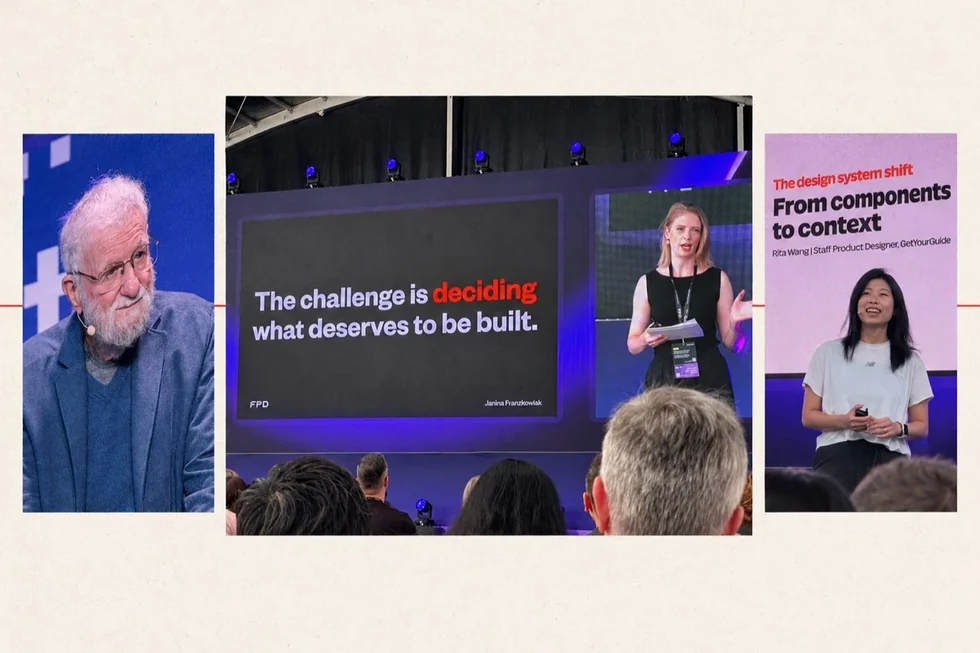
Give discovery a stopping pointJanina Franzkowiak
Research should help resolve a specific decision. A further insight is useful when it can change the next action.
- Start with the decision and its owner.
- Compare the cost of a mistake, the cost of delay and how easily the action can be reversed.
- Agree in advance what evidence would justify taking the next step.
Write a decision card covering the question, owner, uncertainty, test and when to stop collecting evidence.
Track time to decision and the quality of the eventual choice. Check the resulting outcome separately.
Sound as part of a design systemKarsten Kjems / Caroline Rossing / John Cleworth
The session on B&O's audio system extends the idea of consistency beyond visual design.
- Assign a signal to an intention and a product state before choosing its sound.
- Treat sounds as a family with meaning, duration, intensity and contexts of use.
- Provide a visual equivalent and a way to mute sound.
Map three states: in progress, needs attention and complete. Test what sound adds alongside the visual message.
Observe whether people notice and understand the signal and whether it distracts them in their real environment.
Give each decision an ownerJulia Frederking
Good data can coexist with friction between teams. Unclear authority and conflicting priorities can block action.
- Look for friction in handoffs and dependencies.
- Name the owner, the quality criterion and when to consult others.
- Check for rework elsewhere before counting a local saving.
Map one workflow from intent to launch, including decisions, handoffs, corrections and escalations. Mark the steps without an owner.
Track time to decision, number of handoffs and work repeated after approval.
Broaden the scope of responsibilityDon Norman
Humanity-Centered Design includes people and environments beyond the immediate user and screen.
- Consider the community, operators, culture and environment.
- Co-design with people who experience the consequences.
- Check the reliability of AI-assisted learning and analysis before acting on the results.
Add the people who handle errors or bear the cost of automation to your user map. Walk through one difficult scenario with them.
Look at the workload across the full process and the effects on groups the first analysis missed.
Four questions before building a prototypeAther Nawaz / Jesper Poulsen-Hansen
Ørsted's compass aligns strategy, execution, insights and technology. It gives a team a common point of reference.
- Strategy: what goal and problem justify this work?
- Insights: what evidence informs the choice?
- Execution and technology: who decides, what is in scope, and what will maintenance require?
Answer four short questions before generating a prototype. Mark missing answers so the team can resolve them.
Count assumptions surfaced before building and direction changes after showing the prototype.
Use the prototype to ground the conversationDian Wessels
Design can shape collaboration by making the problem visible and letting a team test its assumptions early.
- Involve design before the team commits to a roadmap solution.
- Show a prototype or process map so different teams can discuss the same thing.
- Invite feedback and keep the decision owner visible.
In one review, show the problem, evidence and two options. Close by naming the decision, owner and information that could change the choice.
Look for changes in how the team understands the problem, assumptions it resolves and the corrections that follow.
From components to contextRita Wang
Michał's public essay on Rita's session describes a gap between access to components and knowing when to use them.
- Describe when a pattern fits, when it is unsuitable and why it exists.
- Record composition rules and design decisions that component props leave implicit.
- Record missing context, sources, exceptions and human corrections.
Ask an agent to prototype one flow. Compare its choices with the standard and turn recurring gaps into documentation updates.
Count components recreated from scratch, missed rules and recurring corrections. Evaluate the result alongside the usage report.
Give people a useful starting pointChristian Kuhn
Choices, context and direct manipulation can help a person express intent before writing a prompt.
- Offer a starting action that fits the current task.
- Give people a way to refine the goal and boundaries of the action.
- Make advice, drafting and execution after approval distinct steps. Keep the result correctable.
Compare a blank chat with goal and context selection for one feature. Keep a text entry option for unusual tasks.
Observe time to a useful result, meaningful corrections and whether people can regain control.